
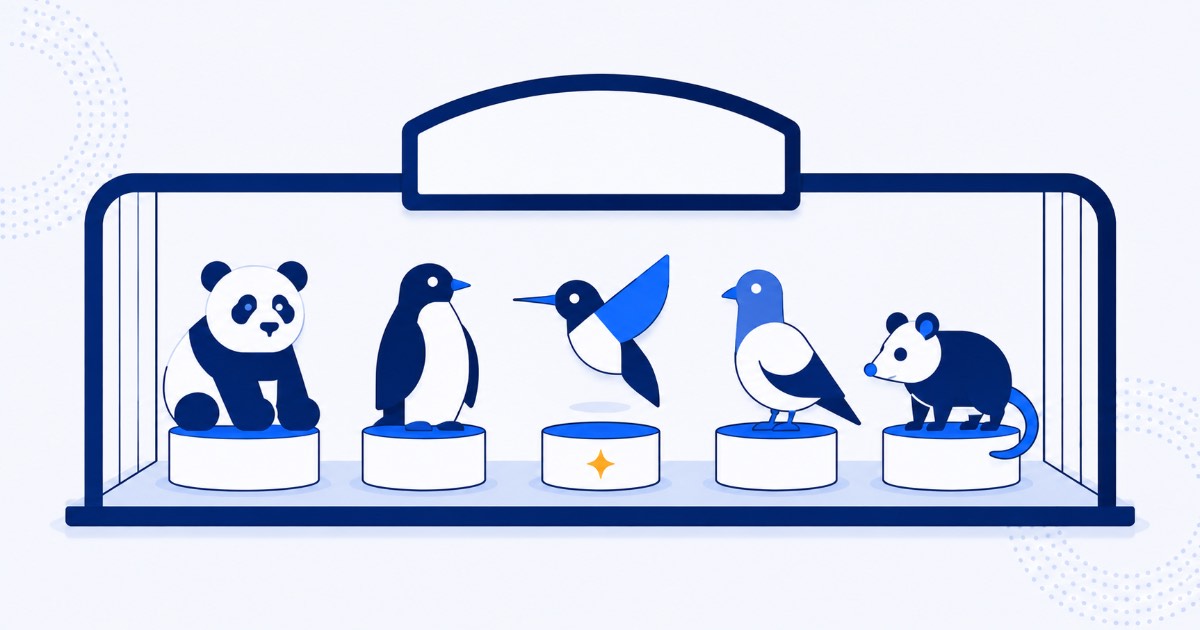
Between 2011 and 2017, Google shipped a series of algorithm updates named after animals: Panda, Penguin, Hummingbird, Pigeon, Possum, and a few stranger creatures besides. Each one arrived quietly, wiped out a thriving industry of shortcuts overnight, and left behind a rule that still governs SEO today. The names came from Google engineers and journalists rather than any grand naming scheme, and the cheerful branding disguised what were, for thousands of websites, extinction events. Here is the tour, in order, with the lesson each animal left behind.
Panda, 2011: the end of content farms
Before Panda, an entire business model existed called the content farm: publish ten thousand shallow articles on every conceivable keyword, hire writers at a few dollars a piece, collect the traffic. It worked spectacularly, and the internet was miserable for it.
Panda, named after the engineer who built it rather than the bear, scored sites on content quality signals and demoted the thin ones wholesale. Some of the largest publishers on the web lost the majority of their traffic in a week. Several never recovered.
The rule it left: quantity without substance is a liability, not an asset. Fifteen years later, every "we will publish 100 AI articles a month" pitch is the content farm wearing a new coat, and it will meet the same fate for the same reason.
Penguin, 2012: the link market collapses
If Panda killed bad content, Penguin killed bad links. A whole economy existed around buying them: directory blasts, blog networks, forum comment spam, anchor text stuffed with commercial phrases. Agencies sold packages. Everyone knew.
Penguin devalued manipulative link profiles, and the collapse was brutal enough that "negative SEO", pointing spam links at a competitor to sink them, briefly became a real fear. Google eventually taught Penguin to ignore bad links rather than punish for them, which is why the disavow tool matters far less today than the panic of 2012 suggested.
The rule it left: a link is worth something only because it was not bought, an economics lesson we cover properly in our guide to backlinks.
Hummingbird, 2013: search learns to read
The gentlest animal in the zoo, and the most consequential. Hummingbird rebuilt how Google interpreted queries: instead of matching keywords, it began interpreting meaning, so "where can I get a phone fixed near me" could be understood as a request rather than a string.
Nobody lost their rankings overnight, which is why Hummingbird gets less attention than it deserves. What died instead was an entire writing style: the keyword-stuffed page repeating "cheap phone repair London" nineteen times, which suddenly read as gibberish to a machine that finally understood language.
The rule it left: write for the question, not the phrase. Everything since, RankBrain, BERT, and the AI answers of today, is the same trajectory continuing.
Pigeon, 2014: local search grows up
Pigeon, named by a publication rather than Google, rewired local results to lean on traditional ranking signals. Suddenly a strong website mattered for the map results, not just a well-filled profile, and businesses that had treated their site as a formality found themselves outranked by neighbors who had not.
The rule it left: local visibility is a system, profile plus website plus reputation, which is exactly how our Google Maps checklist is structured.
Possum, 2016: the one that played dead
Best name in the zoo, because businesses affected by it appeared to vanish while being perfectly alive. Possum filtered results to reduce near-duplicate listings, so two businesses sharing an address or category could see one hidden from view. Owners assumed a penalty; it was a filter.
The rule it left: not every disappearance is a punishment. Before panicking about a drop, diagnose it, which is the entire point of our guide to why a site stops showing up on Google.
Fred, 2017: the joke that stuck
The last animal is not one. When a journalist asked what to call an unnamed update, a Google engineer joked that all future updates should be called Fred, and the name stuck permanently to a 2017 update that hit sites stuffed with ads and thin affiliate content.
Fred also marked the end of the naming era. Google now ships broad core updates several times a year with no names at all, partly because the animal branding made each one feel like a singular catastrophe rather than routine maintenance.
The rule it left: if a page exists to serve ads rather than readers, an update will eventually notice.
What the zoo was really doing
Read the list in sequence and a single pattern appears. Every animal closed the gap between what ranked and what deserved to rank. Panda closed it on content, Penguin on links, Hummingbird on language, Pigeon and Possum on local honesty, Fred on greed.
Which makes the practical takeaway almost boring, and worth stating anyway: every extinction event in search history has killed shortcuts, and none has ever killed a business doing the actual work. The AI era continues the same trajectory, as we explain in where AI answers come from: assistants reward the same properties, consistency, structure, and genuine expertise, that survived every animal in this zoo.
Frequently asked questions
Does Google still name its algorithm updates?
Rarely. Most updates now ship as unnamed broad core updates several times a year, alongside named systems like the helpful content work and spam updates. The animal era ended around 2017.
Are Panda and Penguin still running?
Not as separate updates. Both were folded into Google's core ranking systems years ago, which means their judgments now happen continuously rather than in dramatic monthly releases. The rules survived; the events stopped.
How do I know if an update hit my site?
Check whether your traffic drop lines up with a confirmed update date, and whether it hit one section or the whole site. Sudden total disappearance is usually technical rather than algorithmic; gradual erosion across many pages is more often a core update reassessing quality.
What should I do after a core update drops my rankings?
Resist the urge to rewrite everything in week one. Confirm the timing, identify which pages lost, compare them honestly against what now outranks them, and improve the weakest material. Recovery typically comes with a later update rather than immediately, which is why patience is a genuine SEO skill.
The bottom line
The Google zoo is a decade of proof that search rewards substance eventually, even when shortcuts win temporarily. Every animal took something away, and every one of them left the same instruction behind: be the result the searcher actually wanted. If you want to know whether your site is on the right side of that history, our free SEO and AEO audit will tell you plainly, no taxidermy required.