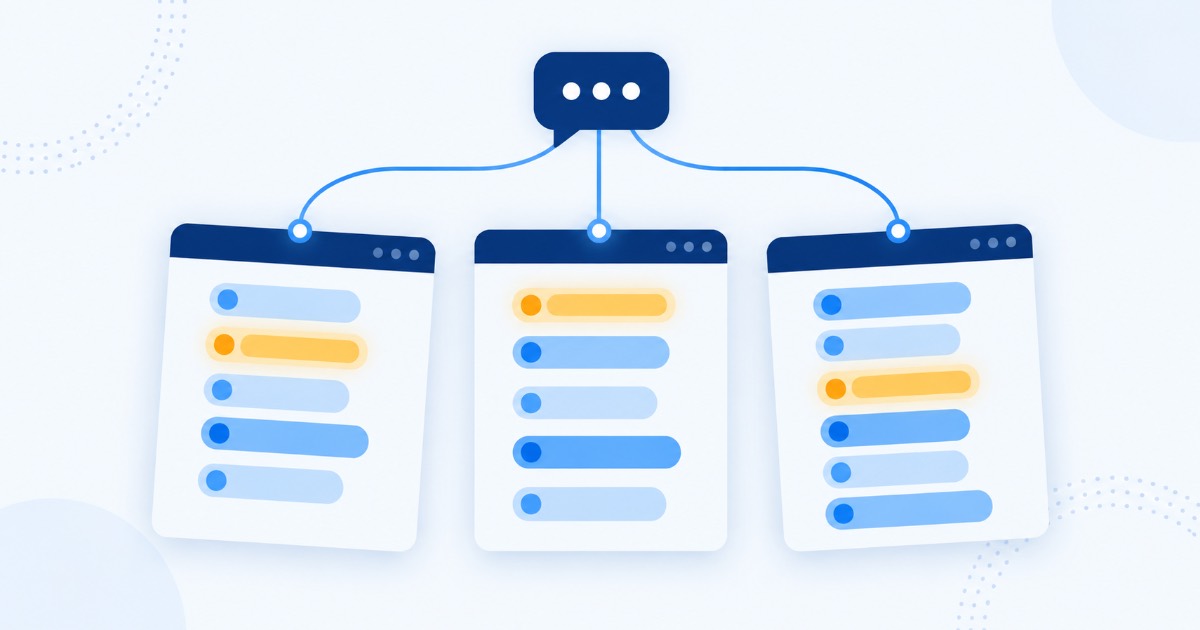

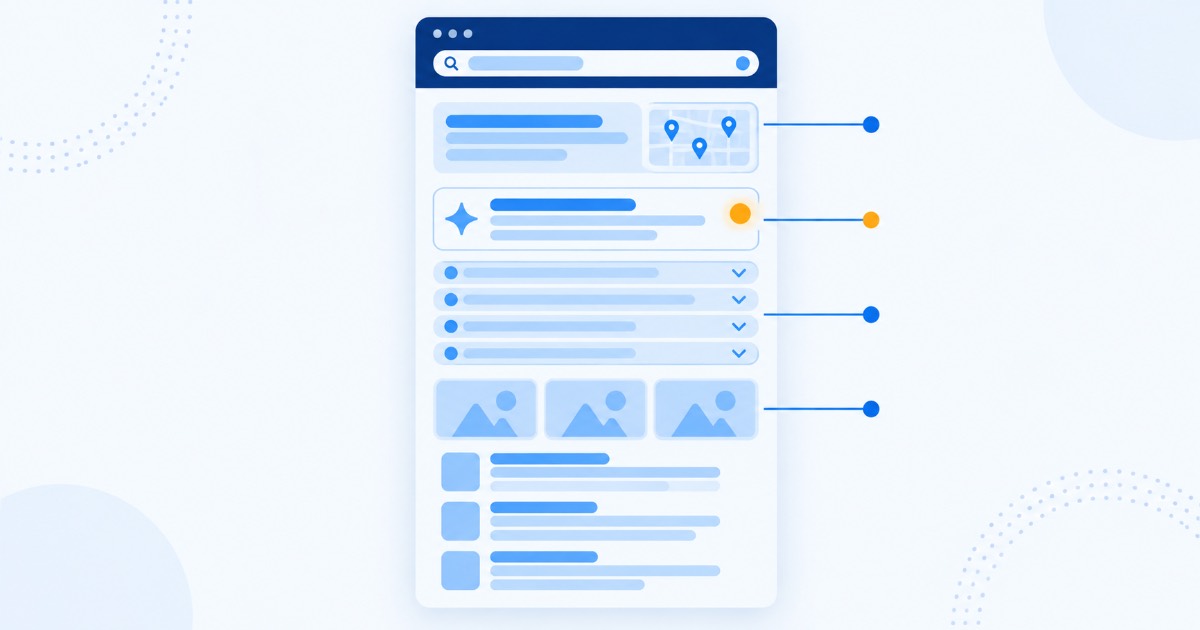
The classic idea of a Google results page, ten blue links in a column, has not described reality for years. A single search today can return an AI summary, paid listings, a featured snippet, expandable questions, a map with three local businesses, a knowledge panel, images, videos, product listings, and forum discussions, with the traditional organic results scattered between them. Each of those is a separate competition with its own rules, and most businesses compete in exactly one while ignoring the rest. Here is the full tour, element by element.
1. The AI Overview
What it is: a generated summary at the top of the page, usually with a handful of cited sources.
What triggers it: informational questions most often, commercial ones increasingly.
How to compete: answer the question directly in your opening sentences, structure the page with clear headings, and mark up your facts. Being cited here is a different achievement from ranking, and worth tracking separately, as we cover in our zero-click guide.
2. Paid results
What it is: auction-based listings above and below the organic results, labelled as sponsored.
How to compete: you buy in, and quality score still rewards relevance, so better landing pages cost less per click. Worth knowing: paid presence has no effect whatsoever on organic position.
3. The featured snippet
What it is: an extracted answer box, drawn from one page, sitting above the standard results.
What triggers it: questions with a clean, extractable answer, particularly definitions, steps, and comparisons.
How to compete: answer in roughly forty to sixty words immediately under a heading phrased as the question. Use a numbered list for processes and a table for comparisons, because the format you supply is usually the format that gets lifted. You do not need the top organic position to win one, which makes it the best-value target on this list.
4. People Also Ask
What it is: an expanding set of related questions, each with its own extracted answer.
How to compete: include those questions verbatim as subheadings with concise answers beneath. This is also free research, since the box is effectively Google showing you the question cluster around your topic, which is why our keyword research guide treats it as a primary source.
5. The local map pack
What it is: a map with three business listings, shown for anything with local intent.
How to compete: a complete Google Business Profile, the most specific primary category, a steady flow of reviews with replies, and consistent name, address, and phone details everywhere. The full method is in our Google Maps checklist. For a local business this single element often outperforms every other result on the page.
6. The knowledge panel
What it is: the information box about an entity, typically on the right on desktop.
How to compete: you cannot buy or directly create one. You earn it by being an unambiguous entity: consistent descriptions everywhere, Organization schema, presence in the reference sources Google trusts, and a claimed profile where one exists.
7. Sitelinks
What it is: the sub-links listed beneath your main result, usually for brand searches.
How to compete: clear site structure, descriptive page titles, and sensible internal linking. They are generated automatically, so the work is making your hierarchy obvious rather than requesting anything.
8. Image and video results
What it is: a row of images or a carousel of videos embedded in the results.
How to compete: descriptive file names and alt text, images that genuinely illustrate the topic, and for video, titles matching real questions plus accurate transcripts. Many businesses ignore both entirely, which makes them unusually winnable in service categories where visual proof matters.
9. Product and shopping results
What it is: product listings with prices, ratings, and merchants.
How to compete: an accurate product feed, complete structured data, honest pricing and availability, and reviews. Accuracy matters more than cleverness here, because mismatches between listing and landing page are penalised quickly.
10. Rich results on organic listings
What it is: the extras attached to a normal listing: star ratings, FAQ expanders, recipe times, event dates, breadcrumbs.
How to compete: valid structured data that genuinely matches visible page content. These do not directly raise your position, and they make your listing occupy more space and attract more clicks from the position you already hold, which is the cheapest click-through improvement available to most sites.
11. Discussions and forums
What it is: results drawn from community platforms, surfaced for questions where people want opinions rather than pages.
How to compete: not by spamming. Genuine participation where your customers already talk, which doubles as AI visibility work, though with the platform-dependency caveat we set out when Reddit's citation share collapsed in ChatGPT.
12. Related searches and the refinement row
What it is: suggestions before and after the results that reshape the query.
How to compete: indirectly, by covering the adjacent topics those suggestions reveal. They are a map of the journey around your query, which matters more now that the search box itself expands queries, as covered in our piece on Google's rebuilt search box.
How to use this strategically
- Look at the actual page before writing anything. Search your target query and see which elements appear. That layout tells you what Google thinks the query means and which competitions are even available to you.
- Pick the winnable ones. Featured snippets, People Also Ask, rich results, and the map pack can all be won without holding the top organic position.
- Match the format that is already winning. If the page is full of video and images, a wall of text will not break in regardless of quality.
- Stack elements on one query. Appearing as the snippet, in the questions, in the map, and in the organic results simultaneously crowds out competitors in a way one blue link never could.
- Accept the shrinking share. Traditional organic results occupy less of the screen every year, which is an argument for entering more competitions rather than optimising harder for one.
Frequently asked questions
Do featured snippets steal my traffic?
Sometimes they answer the question completely and the click never happens; sometimes they give you the most prominent position on the page and a visible endorsement. For commercial queries the exchange usually favours you; for simple factual lookups it often does not, which is a reason to target snippets on questions that lead somewhere.
How do I know which elements appear for my keywords?
Search them and look, in an incognito window, on both mobile and desktop, since layouts differ substantially between the two. Ten minutes of manual observation beats any assumption.
Can I opt out of having my content used in these features?
There are controls that limit how your content appears in some features, and using them generally reduces your visibility rather than protecting it. For most businesses seeking customers, opting out means opting out of the page.
Which element should a small business target first?
If you serve a local area, the map pack, without hesitation. Otherwise, featured snippets and People Also Ask, because both reward clear answers rather than domain authority, which is the one advantage a smaller site genuinely has.
The bottom line
A results page is a dozen competitions wearing one outfit, and most businesses have entered only the hardest of them. Look at the page you are actually trying to win, identify which elements are in play, and target the ones that reward clarity and structure rather than sheer authority. If you want to know exactly which elements your target queries display and which you are eligible to win, our free SEO and AEO audit maps them query by query, so your effort goes where the openings actually are.