Most About pages were written once, in a hurry, and never touched again. That is a missed opportunity, because this page is now read by three very different audiences. Customers visit it to decide whether to trust you. Journalists check it before they quote you. And AI assistants rely on it to understand who you are, what you do, and whether to recommend you. A good About page answers all three in a couple of minutes of reading. Here is how to write one.
Who reads your About page
- Customers close to buying. People rarely visit an About page by accident. They go there when they are interested and want reassurance that a real, capable business is behind the website.
- Journalists and partners. Before quoting you, featuring you, or working with you, people check who you are. A clear About page makes you easy to say yes to, which is a big part of getting quoted in the media.
- Search engines and AI assistants. Your About page is one of the clearest statements of who you are on the entire web. When it is specific and consistent, these systems describe you accurately. When it is vague, they fill the gaps from elsewhere, sometimes wrongly, as covered in fixing wrong AI information about your business.
The 10 things every About page needs
- 1. What you do, in one sentence. Put it first. Plain words, no slogans.
- 2. Who you do it for. Name your customers so the right people recognise themselves.
- 3. Where you are and where you work. Your town, your region, or "online, worldwide," stated clearly.
- 4. When you started. A founding year is a simple, powerful trust signal.
- 5. Why you started. One short, honest story. The problem you saw, or the moment you decided to do it yourself.
- 6. Real people. Names, roles, and real photos of the people behind the business. Never invent team members or use AI-generated headshots, which Google now names as deception, as we covered in its updated rules on AI content.
- 7. Proof. Customers served, years of experience, qualifications, awards, or genuine press coverage. Only what is true and checkable.
- 8. How you work. What makes your process different: one point of contact, fixed prices, local suppliers, a guarantee.
- 9. Your official details. Your exact business name, address, and contact details, matching every other listing word for word.
- 10. A next step. End with a clear invitation: book a call, visit, get a quote, or see your work.
A fill-in template
Use this as a starting point, then rewrite it in your own voice.
"[Business name] [does what] for [whom] in [where]. We started in [year] when [founder] [short, honest origin story]. Today, our team of [number] [describe the team simply] has [proof: customers served, projects completed, years of experience]. What makes us different is [how you work]. [One or two sentences on what you care about, shown through a specific example.] If you [customer need], [clear next step]."
Then add your team section with names, roles, and real photos, and finish with your official contact details.
Before and after
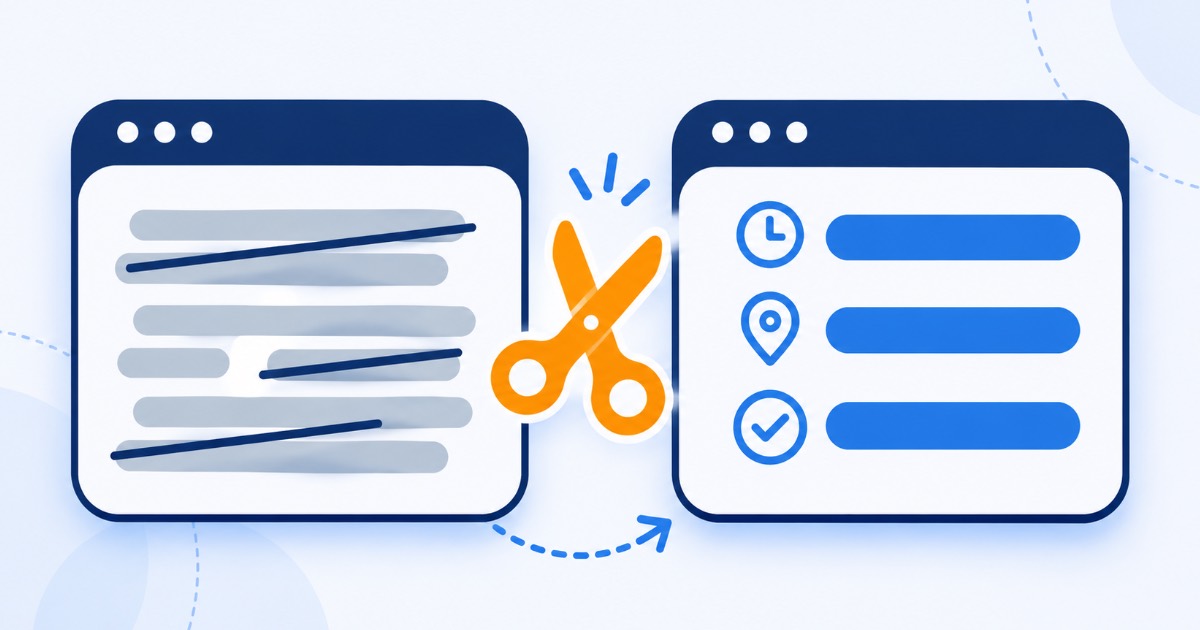
| Before | After |
|---|---|
| We are a passionate team dedicated to delivering excellence and exceeding expectations. | We are a team of four electricians who rewire older homes in Brighton, without ripping out original features. |
| Founded on the values of integrity and innovation, our mission is to empower our clients. | Maria started the practice in 2014 after seeing small charities overpay for basic accounting. Today, we look after the books of 60 local charities. |
| Contact us today to find out how we can help you. | Most projects start with a free 20-minute call. Pick a time here. |
If the "before" column sounds familiar, our list of 40 words that make customers tune out will help you rewrite the rest of your site too.
Help search engines and AI read it clearly
- Use your official business name exactly. The same spelling and format everywhere, a habit we explained in The Name Game.
- Write key facts as plain text. Founding year, location, and services should be in the words on the page, not only in images or graphics.
- Add Organization markup. Structured data that names your business, logo, and official profiles reinforces what the page says. Our guide to schema markup explains what is worth adding.
- Link to your official profiles. Your social accounts, listings, and any genuine coverage help connect your business to its presence across the web.
- Keep it current. Update team changes, new services, and new milestones as they happen. An About page that mentions people who left years ago undermines everything else on it.
Mistakes that make About pages useless
- A wall of mission-statement language that could belong to any business in any industry.
- No people. A faceless About page makes a business feel less trustworthy, not more professional.
- Stock photos of strangers pretending to be your team.
- The life story with no point. Your history matters only where it explains why customers should trust you today.
- A dead end. Interested readers reach the bottom with nowhere to go. Always give them a next step.
- Burying it. If your About page is hidden in the footer, link to it from your main menu and your homepage, which also helps you pass the five-second homepage test.
Frequently asked questions
What should I put on my About Us page?
What you do, who you serve, where you are, when and why you started, the real people behind the business, proof such as experience or results, how you work, your official contact details, and a clear next step. Lead with what you do, not with your mission statement.
How long should an About page be?
Long enough to answer who you are, what you do, and why someone should trust you, which is usually 300 to 600 words plus a team section. Clear and specific matters far more than long.
Does an About page help SEO?
It helps search engines and AI assistants understand your business, which supports how accurately you are described and recommended. It rarely ranks for competitive searches on its own, but it strengthens the trust and clarity of your whole website.
Should I show my team on my About page?
Yes, if you can. Real names, roles, and photos make a business feel trustworthy and human. If you work alone, a photo and short bio of yourself is just as powerful. Never use invented people or AI-generated faces.
Should my About page be written in first person or third person?
Either works. "We" and "I" feel warmer and suit most small businesses. Third person can suit more formal firms. The most important thing is to be consistent and specific.
The bottom line
Your About page is no longer a formality. It is where customers decide to trust you, where journalists decide to quote you, and where AI assistants learn how to describe you. Spend one hour rewriting it this week using the 10 elements and the template above. It may be the most valuable hour you spend on your website all year.
Want to know how clearly search engines and AI assistants understand your business today? Our free SEO and AEO audit shows how your website reads to them, and exactly what to fix so they describe you accurately.