
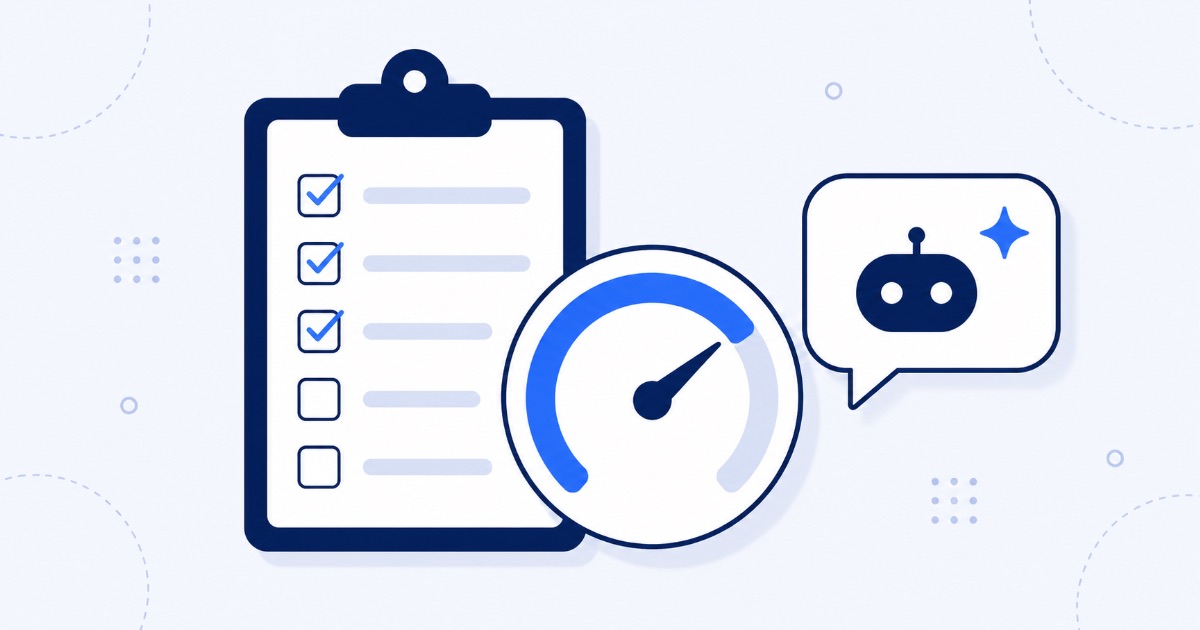
You can measure your AI visibility yourself in about 15 minutes: ask the major assistants six specific questions about your market and your business, check six data points on your own website and profiles, score each answer 0, 1, or 2, and read your total out of 24 against the bands below. No tools, no signup, no expertise required. Most businesses that take this test for the first time score under 10, and every point you miss maps to one specific fix. Here is the full test.
Why guessing is the expensive option
AI assistants answer millions of buying questions daily and name only a handful of brands per answer. Businesses assume they are either safely included or hopelessly excluded, and both assumptions are usually wrong. The test below replaces the assumption with a number you can track monthly, the same way you track rankings. Take it in fresh chat sessions with no history, because assistants personalize toward what they already know about you, and you want the answer a stranger gets.
Part A: What the assistants say (six questions, 0 to 12 points)
Ask questions 1 to 3 in ChatGPT, Gemini, or Perplexity, ideally all three, and score the worst result. Score each question: 2 points for a correct, favorable result, 1 for partial or partly wrong, 0 for absent or wrong.
- Q1. The recommendation test. Ask: "What are the best [your category] in [your city or market]?" Score 2 if you are named unprompted, 1 if you appear only after a follow-up like "any others?", 0 if you never appear.
- Q2. The identity test. Ask: "What is [your business name]?" Score 2 if the description is accurate and current, 1 if partly outdated or vague, 0 if the assistant does not know you or confuses you with someone else.
- Q3. The comparison test. Ask: "[Your business] vs [your main competitor], which should I choose?" Score 2 for a fair comparison that represents you accurately, 1 for a lopsided or thin one, 0 if the assistant only knows your competitor.
- Q4. The service test. Ask about your most profitable service: "Who offers [specific service] in [market]?" Score as Q1. Being known for your category but not your money-maker is a common and costly gap.
- Q5. The citation test. In Perplexity or any assistant that shows sources, check the answers above: score 2 if your own site or coverage of you appears among the cited sources, 1 if only third-party directories mention you, 0 if your domain never appears.
- Q6. The trust test. Ask: "Is [your business name] legitimate and well reviewed?" Score 2 for a confident yes citing reviews or coverage, 1 for a hedged answer, 0 for uncertainty or negative material you did not know about. This question doubles as an early warning system.
Part B: What your data says (six checks, 0 to 12 points)
These six checks predict how Parts A improves over time, because they are the inputs assistants read.
- C1. The description test. Open your homepage, your Google Business Profile, and your LinkedIn page. Score 2 if all three describe you in essentially the same sentence, 1 if they roughly agree, 0 if each says something different.
- C2. The schema test. Paste your homepage URL into Google's Rich Results Test. Score 2 for valid Organization or LocalBusiness markup, 1 for markup with errors, 0 for none.
- C3. The answer-shape test. Open your most important service page and read only the first two sentences. Score 2 if they alone answer what you do, for whom, and where; 1 if the answer needs the whole page; 0 if the page opens with slogans.
- C4. The mention test. Search Google for "[your business name]" minus your own site. Score 2 if respected third-party pages discuss you, 1 if only directories list you, 0 if the results are just your own profiles.
- C5. The freshness test. Score 2 if you have published anything, news, articles, or updates, in the last 60 days; 1 for the last six months; 0 beyond that. Assistants read the live web, and silence reads as inactivity.
- C6. The question test. Score 2 if your site has a page or FAQ directly answering the top three questions customers actually ask you; 1 if the answers exist but are buried; 0 if they are nowhere.
Reading your AI Visibility Score
- 19 to 24: Visible. Assistants know you, cite you, and recommend you. Your work is defending the position: keep publishing, keep earning mentions, and retest monthly, because these answers shift faster than rankings.
- 12 to 18: Known but not chosen. The usual pattern here is decent data (Part B) with weak recommendations (Part A), which means the machine can see you but has no reason to prefer you. Third-party mentions and comparison content close that gap.
- 6 to 11: A stranger to the machines. Most established businesses land here on their first test. The fastest points are C1, C2, and C3, all fixable within a week, and they feed every Part A score over the following months.
- 0 to 5: Invisible. Painful, and also the range where effort pays fastest, because you are starting from zero in a channel your competitors likely also ignore. Begin with the basics in Part B, then work through our AEO playbook step by step.
Turning misses into fixes
Every question maps to a fix you can schedule:
- Missed Q1, Q4, or C4: you need third-party presence, through digital PR, roundup placements, and community visibility. Our guide to what press releases actually do covers the honest mechanics.
- Missed Q2 or C1: unify your description everywhere, word for word, this week.
- Missed Q3: publish a fair comparison page yourself, because assistants lean on comparison content and currently only your competitor's side of the story exists.
- Missed Q5, C2, or C3: restructure key pages so the answer comes first and the markup validates.
- Missed Q6: address the review gap or the negative coverage before it compounds; assistants repeat what the record shows.
- Missed C5 or C6: start a publishing rhythm around the questions customers already ask you, which is the cheapest content strategy that exists.
Frequently asked questions
How often should I run this test?
Monthly, in fresh sessions, logging the scores in a spreadsheet. AI answers move faster than rankings, and the trend across three months tells you more than any single result.
Why do different assistants give different answers about me?
Each system has different training data, different live-search behavior, and different source preferences. That is exactly why the test scores your worst result rather than your best: your visibility is only as strong as the assistant that forgets you.
My score is high but my rankings are poor. How?
The channels overlap without being identical. Strong third-party mentions can make assistants recommend a site that has not yet earned rankings. Enjoy the head start, and read our SEO vs AEO comparison to keep the two working together.
Can I just pay to appear in AI answers?
Not today. There is no advertising placement inside assistant recommendations, which is precisely what makes earned visibility here valuable, and why early movers keep the seats.
The bottom line
Fifteen minutes, twelve scores, one number you can act on. Take the test, write down your score, and fix the cheapest gaps first: consistency, schema, and answer-first pages. Then retest next month and watch the number move. If you would rather have the full version done for you, with fifty questions across every major assistant and a prioritized fix list, that is exactly what our free SEO and AEO audit includes. Your score out of 24 is the preview; the audit is the whole picture.