
Google is testing a program that pays websites when their content significantly shapes the answers in AI Overviews, AI Mode, and the Gemini app. It is called the AI contribution pilot, it lives inside Search Console, and it is invitation only for now. It is the first time Google has offered money, rather than a promise of traffic, for the content that powers its AI. Before you celebrate, know this: saying no to the money does not stop Google using your content.
What happened
The feature first appeared in Search Console in April 2026, and at the time nobody realised money was involved. On 14 September, Digiday reported that it is in fact a payment program, and Google confirmed to the outlet that it is an early-stage pilot. Since then the story has spread through every corner of the SEO and publishing world, for an obvious reason. For three years, website owners have complained that AI answers use their work and send fewer visitors back. This is Google's first attempt at an answer with a cheque attached.
According to the reporting, the pilot has proved more appealing to small and mid-sized publishers than to big media companies, and it has expanded well beyond news sites. In other words, it is heading toward ordinary business websites, not just newspapers.
What it actually pays for
The mechanics are narrower than the headlines suggest. Based on Google's help documentation as reported, here is how it breaks down.
| Situation | Paid? |
|---|---|
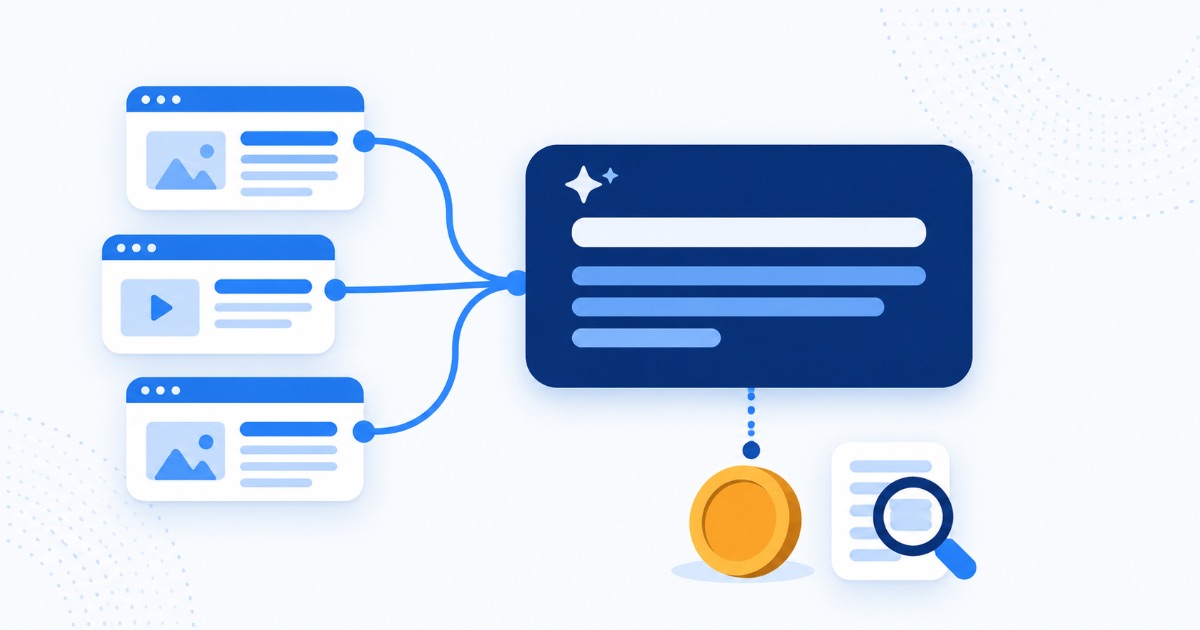
| Your content significantly shapes what the AI answer says while it is being written | Yes |
| Your page appears as a citation link under the finished answer | Not on its own |
| Your content is used to double-check a fact after the answer is written | No |
| Your content appears in the Gemini app, AI Overviews, or AI Mode | Covered products |
That middle row is the surprise. Being cited, the thing most AI visibility tools measure, is not by itself what earns money. Your content has to have influenced the substance of the answer, a process nobody can observe from outside. It connects directly to a pattern we covered in ghost citations, where AI quotes your work but names someone else.
The catch nobody is reading
There are three, and the third is the one that matters most.
- You cannot see how the money is calculated. Members see a monthly earnings figure with some history. There is no breakdown by page, no list of queries, and no published formula. One executive described it to Digiday as quite black box, and early payouts were reported as small next to ad revenue.
- Saying yes may weaken a future complaint. Critics argue that accepting formal payment turns an unpaid use into a consented one. If you ever wanted to argue that AI took your content without permission, signing the terms makes that argument harder.
- Saying no protects nothing. The payment pilot and the AI usage are two separate switches. Turning down the money does not remove your content from AI answers. You get the same usage with no payment attached.
The two switches you need to understand
This is where most coverage gets confusing, so here it is plainly. Search Console now has two different controls, and they do different jobs.
- The AI contribution pilot decides whether you get paid. Joining does not give Google any access it did not already have. Leaving does not take any away.
- The AI controls decide whether your content can ground AI Overviews, AI Mode, and generative features in Discover at all. Switching these off keeps your content out of those answers, but you also give up whatever impressions and visitors those surfaces send you. Google says the choice is not used as a ranking signal for ordinary search results.
So the real decision is not "money or no money." It is "paid usage, unpaid usage, or no usage and less visibility." Framed that way, the answer for most businesses becomes a lot clearer.
Should you opt in if you are invited?
For most independent websites, probably yes, with your eyes open. Declining does not buy protection, it only buys the identical usage for free. The exceptions are publishers with real negotiating power, who may get a better deal through direct licensing, and anyone who believes they have a strong legal claim they want to keep clean.
Whatever you decide, do not decide blind. A payout figure is meaningless unless you know how often your content appears in AI answers to begin with. Start measuring now:
- Check the Generative AI report in Search Console. It shows how often your pages appear in AI Overviews and AI Mode. Our guide to reading Google's AI search data explains where to find it and what it hides.
- Track a handful of the questions that matter to your business over time, so you can spot whether anything shifts after you join.
- Note which pages do the heavy lifting. If a few pages are behind most of your AI appearances, those are the assets any payment should reflect.
What this means for everyone else
Even if you are never invited, this matters. Google has now acknowledged, in practice, that content shaping an AI answer has value worth paying for. The money follows the content that genuinely forms the answer, not the content that is merely linked underneath it.
That rewards exactly the work that wins AI visibility anyway: clear, direct, authoritative answers to real questions, from a brand the systems trust. If you want your content to be the material AI builds its answers from, our guide to getting your brand cited by AI and our explainer on where AI answers come from are the place to start.
Frequently asked questions
What is the Google AI contribution pilot?
It is an invitation-only test, run through Search Console, that pays publishers when their content significantly contributes to answers in the Gemini app, AI Overviews, and AI Mode. Google has confirmed it is an early-stage pilot.
How do I know if I have been invited?
Invited sites see an AI contribution section in Search Console offering to start earning. If you do not see it, you are not in the pilot yet. There is no public application process.
How much does Google pay?
Google has not published rates or a formula. Early payouts were reported as small compared with ad revenue, and members see only a monthly total, with no breakdown by page or query.
If I decline, will Google stop using my content in AI answers?
No. The payment program and AI usage are separate. To keep your content out of AI Overviews and AI Mode, you would use Search Console's AI controls instead, which also means giving up the visibility those features bring.
Does being cited in an AI Overview mean I get paid?
Not on its own, according to the reported documentation. Payment is tied to content that significantly shapes the answer as it is generated, not to appearing as a link beneath it.
The bottom line
Google paying for AI content is real, early, and small. It is a genuine shift in principle, wrapped in terms you cannot fully audit. For most websites, the money is worth taking, because refusing it changes nothing about how your content is used. The bigger opportunity is upstream: becoming the source AI answers are actually built from. That is what Google is now, quietly, putting a price on.
Want to know how visible your site is to Google's AI right now, before any payment figure shows up? Our free SEO and AEO audit shows how search engines and AI systems read your pages, and exactly what would make your content the kind AI answers are built from.