
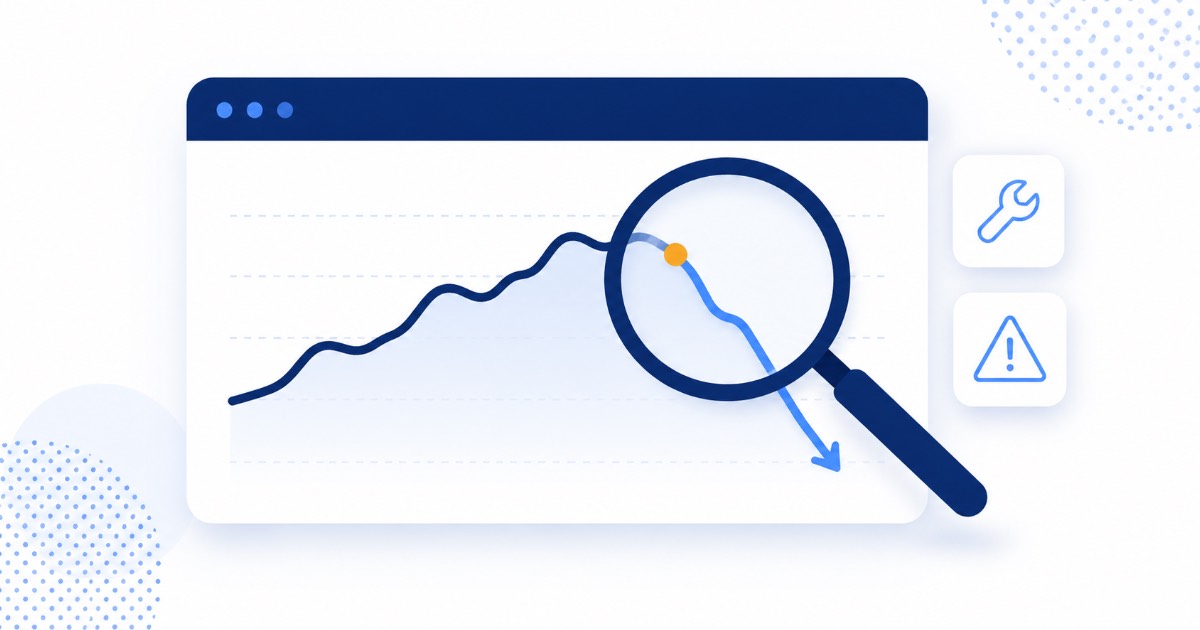
When organic traffic drops, resist the urge to fix anything for the first hour. The shape of the decline already tells you the cause: a vertical cliff overnight is almost always technical, a slide starting on a known update date is algorithmic, a slow fade over months is competitive, and a drop confined to one section is usually something you shipped. Diagnose first, because the six causes need six different responses, and the most expensive mistake in SEO is rewriting a site that had a broken tag.
Step 1: Confirm the drop is real
Before anything else, rule out measurement problems, which cause a surprising share of panics:
- Check Search Console, not just analytics. Analytics breaks when tags get removed, consent banners change, or a developer ships a new template. Search Console reports impressions and clicks independently of your site's tracking code.
- Compare like with like. Month-over-month comparisons in a seasonal business produce phantom drops. Compare to the same period last year as well.
- Check whether it is traffic or conversions. Stable sessions with falling enquiries is a different problem entirely, usually a broken form, and one worth checking before you touch SEO at all.
Step 2: Read the shape of the graph
Open Search Console's Performance report, set the range to sixteen months, and look at the outline of the decline. Each shape has a short list of suspects:
- A cliff, near-zero overnight: technical. Something is blocking Google entirely: a noindex tag shipped with a release, a robots.txt disallow, a failed migration, an expired domain or certificate, or server errors. Our guide to why a site stops showing up on Google walks the full checklist.
- A step down of 20 to 60 percent over a few days: algorithmic. Check the date against confirmed Google core updates.
- A gradual slide over months: competitive or content decay. Someone published better material, or yours aged out of relevance.
- A drop in one section only: something you changed. A template edit, a URL structure change, a page consolidation, or removed internal links.
- Impressions steady, clicks falling: the results page changed around you. An AI Overview, more ads, or new features are absorbing the clicks you used to get.
- Both falling on branded terms: demand problem, not SEO. Fewer people are searching your name, which points at marketing or reputation rather than rankings.
Step 3: Match the cause to the response
If it is technical
Fix immediately, then request reindexing. Check the noindex tags, robots.txt, canonicals, server response codes, and any redirect chain from a recent migration. These are the fastest recoveries in SEO, often complete within days, which is exactly why diagnosis order matters.
If it is a core update
Do not panic-rewrite in week one. Identify which pages lost rather than assuming the whole site is affected, then compare those pages honestly against whatever now outranks them: does yours answer the question better, show real experience, and stay current? Improve the weakest material substantively. Recovery generally arrives with a later update rather than immediately, so the work is patient rather than frantic.
If it is competitive decay
Take your top twenty declining pages, search their target queries, and read what beat you. Usually the winner is more current, more complete, or better structured. Refreshing existing pages is nearly always faster and cheaper than publishing new ones, and it is the most underrated activity in content marketing.
If you changed something
Retrace the deployment history around the drop date. URL changes without redirects, removed internal links, deleted pages, and template changes that stripped headings or content are the usual culprits, and most are reversible in an afternoon.
If the results page changed
This is the modern one, and it is not recoverable by ranking harder: if an AI Overview now answers the query, the click was absorbed before anyone reached your listing. The response is to compete for the citation instead of the click, and to shift measurement toward branded search, direct visits, and citation share. Our AI visibility self-test gives you the baseline, and the AEO playbook covers the work.
If it is a manual action
Rare, and Search Console tells you outright under Manual Actions. Fix the violation properly, document what you did, and file for reconsideration. Do not attempt this while also making unrelated changes, because you will not know what worked.
What not to do while diagnosing
- Do not change many things at once. Simultaneous changes destroy your ability to learn what mattered.
- Do not disavow links reflexively. Google ignores most spam links automatically, and the tool causes more harm than good in untrained hands.
- Do not delete pages in a hurry. Losing rankings is recoverable; losing the page and its links often is not.
- Do not buy your way out. The offers that arrive in your inbox during a traffic drop are the worst deals in the industry, aimed precisely at people who are panicking.
Frequently asked questions
How long does recovery from a core update take?
Improvements are typically confirmed at a subsequent core update, which means weeks to a few months rather than days. Sites that improve genuinely tend to recover; sites that only reshuffle keywords generally do not.
Is a 10 percent drop something to worry about?
Usually not on its own. Organic traffic fluctuates with seasonality, results page changes, and normal ranking movement. Investigate sustained declines and sharp breaks; ignore ordinary noise.
My rankings are the same but traffic fell. What happened?
Your position held while the page around you changed: an AI Overview, more ads, a new feature, or a competitor with a far more compelling title and description. Check your click-through rate in Search Console, and treat titles as the cheapest experiment available.
Should I tell my agency or fix it myself?
Tell them immediately, and expect a diagnosis rather than reassurance. A good agency will show you the shape of the graph, name the suspected cause, and explain the plan, which is exactly the standard set out in our guide to choosing an SEO agency.
The bottom line
A traffic drop is information, not a verdict. The graph tells you which of six problems you have, Search Console confirms it, and each cause has a specific response that has nothing to do with the others. Diagnose in order, change one thing at a time, and be patient with the algorithmic cases, because rushing is how a recoverable drop becomes a rebuild. If you would like a second opinion on what happened to your traffic, our free SEO and AEO audit includes a drop diagnosis: what changed, when, why, and what to do first.