

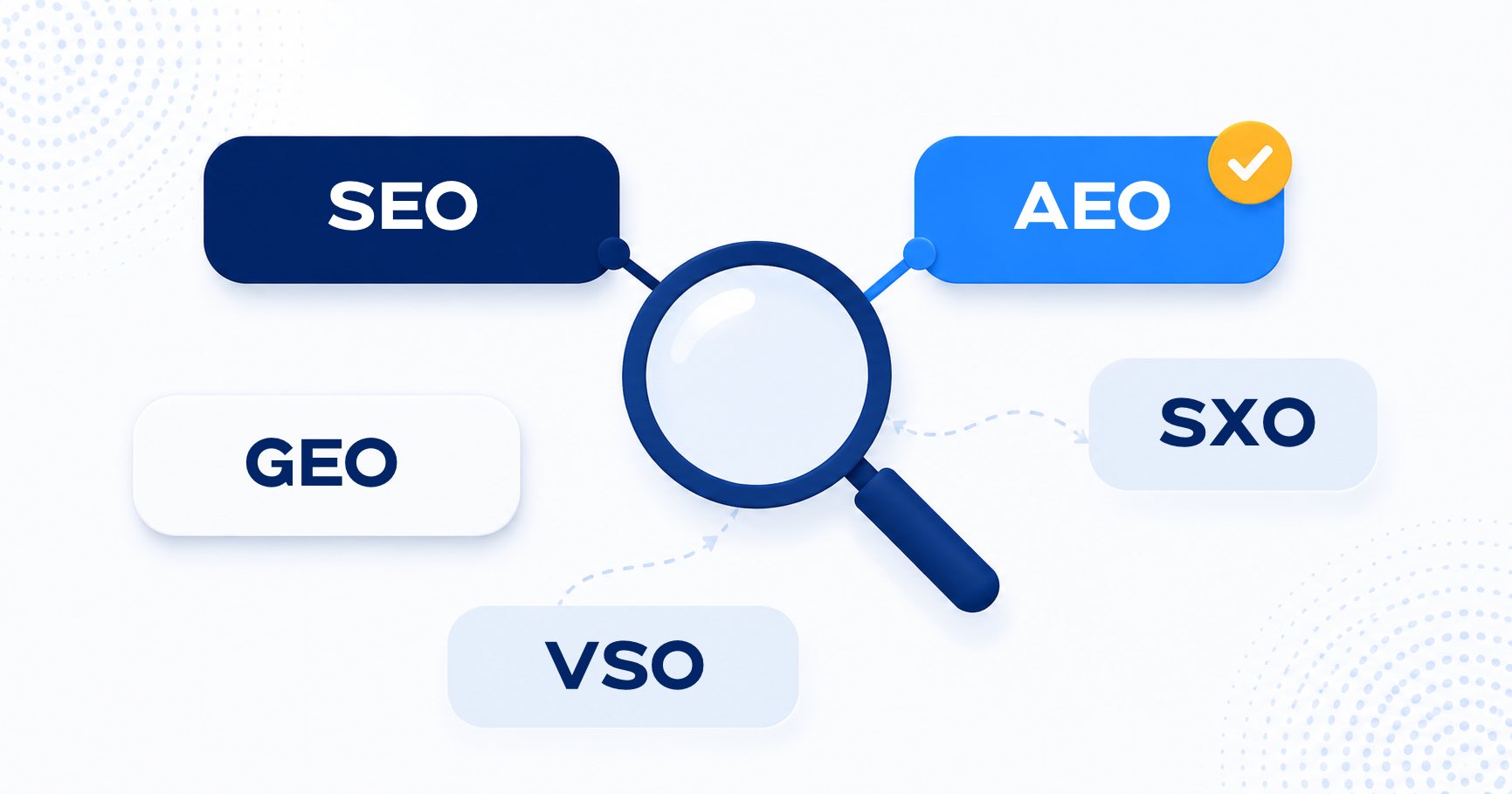
Here is the short version. SEO is the parent discipline: earning visibility in search. AEO and GEO are two names for essentially the same newer work, getting cited inside AI-generated answers, with AEO the more common term and GEO the one favored by academic papers. SXO describes optimizing the experience after the click. LLMO, AISO, and their cousins are mostly rebrands of AEO. ASO and VSO are genuinely separate surfaces, app stores and voice assistants. Roughly three real disciplines, a handful of legitimate specializations, and a growing pile of synonyms invented for marketing. This guide sorts them.
The decoder table
| Acronym | Stands for | What it actually means | Verdict |
|---|---|---|---|
| SEO | Search Engine Optimization | Earning visibility in search results through content, technical health, and authority | The parent discipline |
| AEO | Answer Engine Optimization | Being cited and recommended inside AI-generated answers | Real and distinct |
| GEO | Generative Engine Optimization | The same work as AEO, named in academic research | Synonym for AEO |
| SXO | Search Experience Optimization | What happens after the click: speed, clarity, conversion | Real, but it is UX and CRO |
| LLMO | Large Language Model Optimization | Getting favorable treatment from language models | Rebrand of AEO |
| AISO / AIO | AI Search Optimization | Visibility in AI search surfaces | Rebrand of AEO |
| VSO | Voice Search Optimization | Being the answer voice assistants read aloud | Real but largely absorbed into AEO |
| ASO | App Store Optimization | Ranking inside app stores | Genuinely separate discipline |
| Local SEO | - | Map results and location-based visibility | Specialization within SEO |
The three that describe genuinely different work
SEO: the foundation everything else stands on
Crawlable pages, content that answers real queries, and authority earned through links and mentions. Nothing that follows works without it, and the reason is mechanical: AI assistants find their sources by searching, so pages that rank poorly rarely get read at all.
AEO (or GEO, take your pick): the citation layer
Getting named inside AI answers requires work SEO alone does not cover: answer-first content structure, valid schema, a consistent brand entity across the web, and mentions on sources assistants trust. The measurement differs too, since you are tracking citations across assistants rather than positions on a page. Our SEO vs AEO comparison covers the split in detail.
On the naming: GEO comes from academic work on generative engines, AEO grew out of the industry, and both describe the same objective. Anyone insisting they are fundamentally different disciplines is usually about to price them separately.
ASO: a different store entirely
App Store Optimization runs on its own ranking systems inside Apple and Google's app stores, with different signals: install rates, ratings, retention, and store-specific metadata. If you have an app, it is a genuinely separate job. If you do not, it is irrelevant to you.
The ones that are really other departments
SXO describes something real, that ranking is worthless if the page then fails the visitor, but the work is user experience and conversion optimization, disciplines that existed long before the acronym. Calling it a search discipline is mostly a way to bundle it into a search retainer.
VSO mattered more when voice assistants were the future of search. Their answers now come from the same systems producing AI answers, so optimizing for voice has quietly become a subset of AEO rather than a separate practice.
How to tell a real discipline from a rebrand
Three questions settle it every time:
- Does it target a different surface? App stores are a different surface. AI answers are a different surface. "LLM optimization" is the same surface as AEO with a different label.
- Does it require different work? If the tactics are identical to something you already do, the acronym is packaging.
- Is it measured differently? Genuine disciplines have their own metrics. AEO tracks citation share; SEO tracks rankings and traffic; ASO tracks installs. A "discipline" with no metric of its own is a marketing term.
Apply those three to any new acronym that appears next quarter, because more will, and you will not need anyone to explain it to you.
What this means for your budget
Most businesses need one integrated program, not five subscriptions. The foundations serve every surface: a fast, crawlable site, content that answers real questions, consistent brand information everywhere, and earned authority. On top of that sit two genuine additions for most companies, the AEO structural layer and, if you have an app, ASO.
Which is why an agency quoting SEO, AEO, GEO, and LLMO as four separate line items is describing one job four times. As we noted in our honest pricing guide, the arithmetic test applies: count the hours of distinct work being promised, not the acronyms.
Frequently asked questions
Is GEO replacing SEO?
No. GEO and AEO describe an additional surface, not a replacement for search results, and both depend on SEO fundamentals to function. Anyone announcing the death of SEO is usually selling the thing they claim is replacing it.
Which acronym should I hire for?
Hire for outcomes rather than labels: more qualified visitors, more citations in AI answers, more leads. Then ask how the work will achieve each one, which is question ten in our guide to choosing an SEO agency.
Do I need a separate strategy for each AI assistant?
No. They differ in details, but all reward the same properties: clear structure, consistent identity, and independent corroboration. One well-executed program serves all of them, which is why our AI visibility self-test scores your worst assistant rather than each separately.
Will new acronyms keep appearing?
Certainly. Every shift in how people find information produces a wave of new terms, some describing genuine change and most describing the same work in fresh packaging. The three questions above are the filter; keep them.
The bottom line
Search has three real disciplines, a few honest specializations, and an expanding vocabulary of synonyms. Learn the underlying work and the acronyms stop mattering: be findable, be structured, be consistent, be genuinely useful, and you are optimized for every surface that exists, including the ones that will arrive with names nobody has invented yet. If you would rather see where your business stands across all of them today, our free SEO and AEO audit measures the surfaces that actually exist, and skips the ones that only exist on invoices.